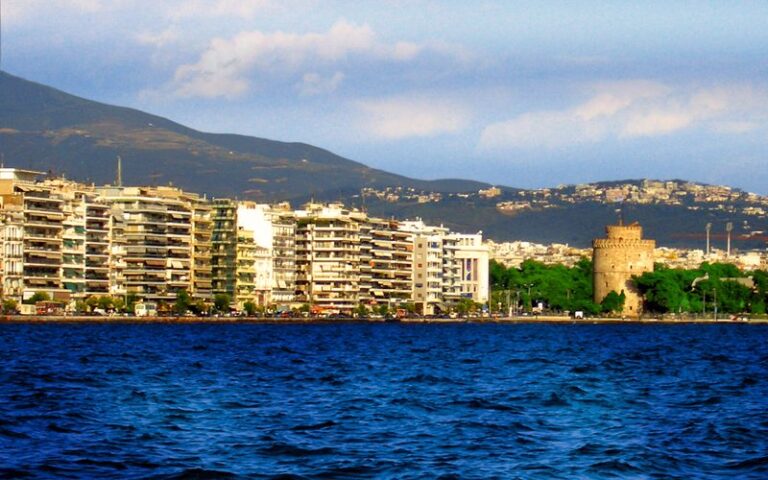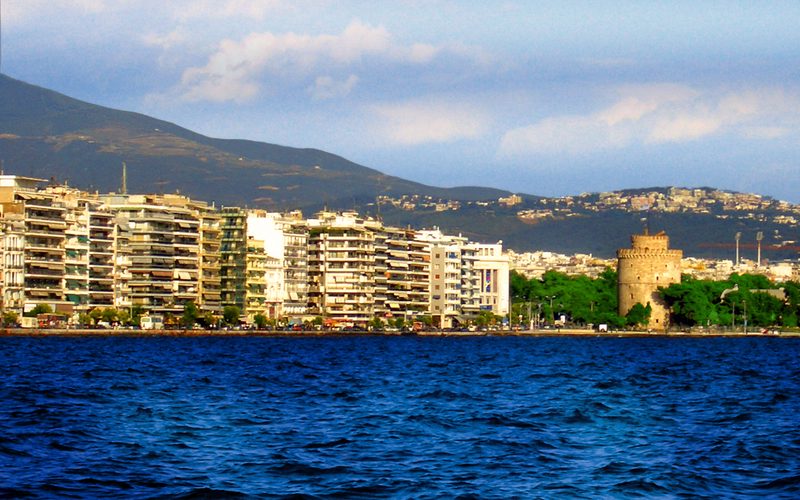
Thessaloniki is Greece’s second largest city, a port metropolis of 1.1 million residents on the Thermaic Gulf in northern Greece. Founded in 315 BC by Kassander, it holds 15 UNESCO World Heritage Byzantine monuments, an unbroken Byzantine-Ottoman-Jewish layered history, and a street food culture that many Greek food writers rank above Athens. LAACOUSTICMUSICFESTIVAL.COM covers Greek destinations with data-first guides built for travelers who research before they book. This guide takes you from arrival through departure: transport, landmarks, food markets, neighborhoods, day trips, and practical costs.
Every section below answers one question a traveler asks before booking. Distances, prices, and journey times are drawn from official operator data and municipal sources.
Where Is Thessaloniki Located in Greece?
Thessaloniki sits at the northern tip of the Thermaic Gulf, 520 kilometers north of Athens. The city anchors the Macedonia region and connects to three Balkan countries within a four-hour drive.
The city center extends along 4 kilometers of waterfront promenade. Mount Chortiatis (1,201 meters) rises directly behind the city, creating a cooler microclimate in summer. The Axios river delta, a Ramsar-protected wetland, lies 20 kilometers west. The Chalkidiki peninsula begins 60 kilometers southeast, giving the city fast beach access without the island ferry dependency that Athens faces.
How Do You Get to Thessaloniki?
Thessaloniki Macedonia Airport (SKG) receives direct flights from 42 European cities and handles 7.2 million passengers per year. Domestic flights from Athens take 45 minutes. The InterCity train from Athens takes 5 hours 15 minutes.
Transport options from the airport to the city center:
- Take bus line 78A from the arrivals hall — it runs every 30 minutes and reaches Aristotelous Square in 45 minutes for €2.
- Book a licensed taxi at the fixed zone rate of €20–€25 for the 16-kilometer transfer.
- Rent a car at the airport; parking in central Thessaloniki costs €1.50 per hour in the blue-zone street system.
OSE’s InterCity rail service departs Athens Central Station six times daily. Travelers starting with Greek islands will fly into SKG rather than combining a ferry with overland travel. If you are planning a broader Greek island route first, the Greek islands guide explains how to structure an island-hopping itinerary before reaching northern Greece.
What Are the Must-See Landmarks in Thessaloniki?
Thessaloniki’s seven primary landmarks are the White Tower, the Rotunda, the Arch of Galerius, the Church of Hagia Sophia, the Archaeological Museum, the Ano Poli Byzantine walls, and the Ancient Agora. All seven are walkable from each other within the city center.
Each landmark represents a distinct historical layer:
- Visit the White Tower, an Ottoman fortification on the waterfront built in the 15th century and now the city’s defining symbol; entry costs €4 and the circular interior displays city history across five floors.
- Enter the Rotunda, a Roman mausoleum built for Emperor Galerius in the early 4th century AD, later converted into a church and then a mosque; its interior dome spans 24.5 meters.
- Photograph the Arch of Galerius (Kamara), a triumphal arch erected in the early 4th century AD to celebrate Roman victories over the Persians, decorated with carved battle reliefs still visible at street level.
- Walk through the Church of Hagia Sophia, an 8th-century Byzantine basilica whose golden mosaics in the dome are original and among the finest surviving in Greece.
- Allocate two hours to the Archaeological Museum of Thessaloniki, which holds 6,000 objects from ancient Macedonia, including the Derveni Krater, a 4th-century BC bronze vessel considered a masterpiece of ancient metalwork.
- Climb to Ano Poli (Upper City), the preserved Ottoman quarter, where wooden mansions built across the centuries line cobblestone lanes and Byzantine walls offer panoramic views over the Thermaic Gulf.
- Walk the Ancient Agora site at the city center, where Roman-era columns and the underground Cryptoporticus are visible beneath street level.
The White Tower receives 200,000 visitors per year. Combined museum tickets cover three sites for €10. Thessaloniki’s 15 Byzantine monuments hold collective UNESCO World Heritage status, awarded for their continuous architectural and artistic significance.
What Is Thessaloniki Known For in Greek Food Culture?
Thessaloniki is the acknowledged street food capital of Greece, producing three dishes that originated here: bougatsa (custard or cheese phyllo pie), koulouri Thessalonikis (sesame bread ring), and trigona Panoramatos (honey-cream triangular pastry). Greek culinary writers consistently rank the city’s food scene above Athens.
Specific places and products define the Thessaloniki food landscape:
- Buy koulouri from carts at Aristotelous Square each morning for €0.30; the Thessaloniki version uses a denser dough and higher sesame seed density than the Athenian variety.
- Eat bougatsa at Bantis or Serraikon on Mitropoleos Street, two institutions that have served the city’s custard-filled phyllo pie for generations.
- Visit the Modiano Market, a covered market hall in the city center, for fresh seafood, Macedonian cheeses, tarama (fish roe paste), and seasonal produce from surrounding plains.
- Try trigona from Terkenlis pastry shop on Tsimiski Street; the triangular phyllo shells filled with cream are among the city’s most exported confections.
- Order grilled offal and souvlaki at the Bezesteni area night market; Thessaloniki souvlaki portions average 30% larger than Athens equivalents at comparable prices.
The Kapani Market (Agora Kapani), adjacent to Modiano, is the older of the two central markets and operates Monday through Saturday from 7 AM to 3 PM. Fish, spices, olives, and bulk goods fill 200 vendor stalls. Thessaloniki’s food markets collectively employ 3,400 vendors in the city center.
Which Neighborhoods Should Visitors Explore in Thessaloniki?
Thessaloniki’s five most distinctive neighborhoods are Ladadika (old merchant quarter), Valaoritou (nightlife district), Ano Poli (Upper City), Kalamaria (coastal suburb), and Toumba (residential football district). Each has a different character and walkable core.
Neighborhood by neighborhood:
- Walk Ladadika, a restored olive oil merchant quarter 600 meters west of the White Tower, where warehouses converted into tavernas and bars fill a pedestrianized grid of 12 blocks.
- Explore Valaoritou, centered on Valaoritou Street, the urban nightlife zone where former industrial buildings house clubs, art spaces, and late-night bars; the district activates after 11 PM.
- Spend a morning in Ano Poli, the hilltop Ottoman neighborhood that survived the catastrophic fire that destroyed the lower city in the early 20th century; its timber-framed houses and Byzantine churches are intact.
- Take a 20-minute bus ride to Kalamaria, the eastern seafront suburb with a yacht marina, beach bars, and a municipal beach free of charge.
- Visit Toumba for a match at PAOK’s Toumba Stadium (capacity 28,703), one of the loudest football atmospheres in southeastern Europe, if a fixture aligns with your dates.
The city center triangle — Aristotelous Square, Egnatia Street, and the waterfront — concentrates hotels, museums, and transport within a 2-kilometer walkable zone. Most visitors base themselves here and take day trips to outlying neighborhoods.
What Is the Best Time to Visit Thessaloniki?
April to June and September to October are the optimal months for visiting Thessaloniki. Daytime temperatures range from 18°C to 26°C. July and August push above 35°C and bring peak hotel rates.
Monthly climate data for planning:
- April: 16°C average, 8 rain days, festivals resume, museums uncrowded.
- May: 21°C average, 7 rain days, outdoor dining fully open, hotel rates moderate.
- June: 26°C average, 5 rain days, waterfront cafés at full capacity.
- September: 25°C average, 4 rain days, Thessaloniki International Trade Fair (700,000 attendees in five days), hotel rates spike.
- October: 20°C average, 7 rain days, Thessaloniki International Film Festival (10 days), restaurants fully operational.
- December: 8°C average, 10 rain days, Aristotelous Square Christmas market, no beach tourism.
The Thessaloniki International Trade Fair in September is the single largest demand event of the year. Book hotels six weeks in advance if visiting during that period. The October Film Festival draws 65,000 attendees and temporarily raises accommodation rates by 40%.
How Much Does It Cost to Visit Thessaloniki?
A mid-range daily budget in Thessaloniki runs €80–€120 per person, covering a three-star hotel at €55–€80, meals at local tavernas for €15–€25, public transport at €2 per trip, and landmark entry fees averaging €4 per site.
Specific costs by category:
- Three-star hotel near Aristotelous Square: €55–€80 per night.
- Boutique hotel in Ano Poli: €70–€110 per night.
- Hostel dorm bed: €18–€28 per night.
- Lunch at a taverna (two courses): €12–€18.
- Dinner at a mid-range restaurant with wine: €22–€35 per person.
- Street food breakfast (koulouri, bougatsa, coffee): €3–€5.
- One-way bus ticket: €1.10 (paper) / €0.90 (RFID card).
- Day trip to Chalkidiki beach by bus: €8–€12 return.
Thessaloniki is 20–30% less expensive than Athens for comparable accommodation and dining. The euro is the only accepted currency. Greek bank ATMs at Aristotelous Square and Tsimiski Street charge no Eurozone withdrawal fees.
What Byzantine Heritage Does Thessaloniki Hold?
Thessaloniki contains 15 early Christian and Byzantine monuments collectively designated as UNESCO World Heritage Sites. These include five complete churches with original mosaic programs and three surviving fortification sections built across ten centuries of continuous use.
The UNESCO designation covers monuments built between the 2nd and 15th centuries AD. The Church of Acheiropoietos is the oldest functioning Byzantine church in the world still holding regular Orthodox services. The Church of Agios Dimitrios, the largest church in Greece at 43 meters long, preserves early mosaic cycles of the city’s patron saint in the nave. The Osios David church in Ano Poli holds a 5th-century mosaic of Christ hidden behind plaster for five centuries of Ottoman rule and emerged intact when discovered.
Byzantine Thessaloniki operated as the second city of the Eastern Roman Empire for centuries, a rank the city still claims culturally. The Byzantine Museum of Thessaloniki on Stratou Avenue displays 3,000 objects spanning ten centuries of Byzantine art, including portable icons, jewelry, and architectural fragments. Entry costs €8.
What Is the Jewish Heritage of Thessaloniki?
Thessaloniki was the largest Sephardic Jewish city in the world from the late 15th century through the early 20th century. The Jewish community numbered 80,000 — more than half the city’s total population — before being destroyed in the Nazi occupation of the Second World War.
The Jewish Museum of Thessaloniki on Agiou Mina Street documents 2,300 years of continuous Jewish presence in the city. The museum holds 10,000 objects including synagogue artifacts, photographs, documents, and personal effects. Entry costs €5. The Monastir Synagogue, restored in the early 21st century after decades of neglect, is the only functioning synagogue remaining from the 32 that existed before the war. The site of the former Jewish cemetery — the largest Jewish burial ground in Europe at 350,000 graves — now hosts the Aristotle University of Thessaloniki campus.
Sephardic Jews arrived in Thessaloniki after their expulsion from Spain in the late 15th century, bringing printing presses and textile expertise that transformed the city into an Ottoman commercial hub. By the early 20th century, the city’s port operated with the Jewish community as its primary labor force, and the city halted on Saturdays to observe Shabbat.
What Day Trips Can You Take From Thessaloniki?
Thessaloniki serves as the base for six major day trips: Vergina (royal Macedonian tombs, 72 km), Pella (Alexander the Great’s birthplace, 40 km), Kavala (Byzantine fortress, 168 km), Chalkidiki beaches (60 km), Meteora (rock monasteries, 215 km), and Edessa (waterfalls, 90 km). All are reachable by car or public bus.
Day trip details:
- Drive 72 kilometers southwest to Vergina to see the Royal Tombs of Aigai, burial site of Philip II of Macedon (father of Alexander the Great); the gold burial larnax and royal diadem are displayed in situ; entry costs €12.
- Visit Pella, 40 kilometers west, the capital of ancient Macedonia and birthplace of Alexander the Great; its archaeological museum displays original pebble mosaic floors from 4th-century BC palace complexes, the finest preserved examples in the world.
- Take the KTEL bus to Chalkidiki in 60 minutes to reach Kassandra Peninsula beaches, which have 65 Blue Flag beaches across 570 kilometers of coastline.
- Drive to Edessa, 90 kilometers west, for the Edessa Waterfalls, where five falls drop 70 meters into the gorge below and the park is free to enter.
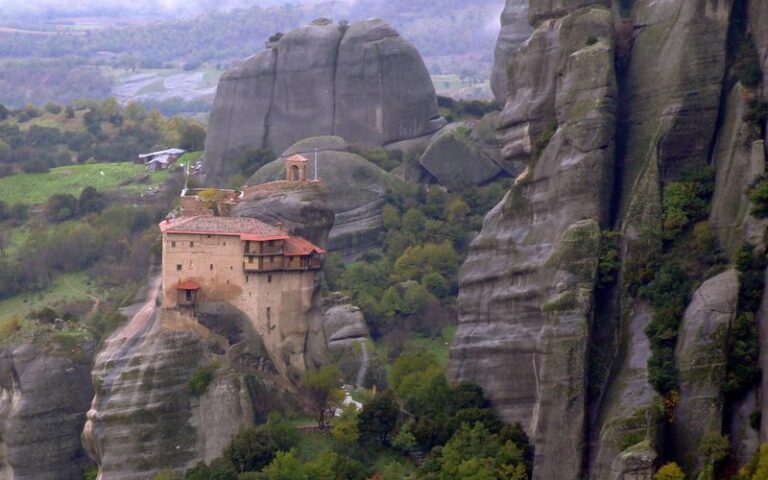
- Combine a two-day trip to Meteora, 215 kilometers south: six active monasteries perched on sandstone pillars at heights of 400 meters are accessible via Kalambaka as a base.
Car rental from Thessaloniki airport averages €35 per day for a compact vehicle in shoulder season. Driving in northern Greece requires an EU license or international driving permit.
What Is the Thessaloniki Waterfront Like?
The Thessaloniki waterfront promenade (Nea Paralia) stretches 3.5 kilometers from the White Tower east to the Concert Hall, redesigned into eight themed gardens with outdoor sculptures, cafés, jogging paths, and cycle lanes. The waterfront is car-free and open 24 hours.
The Nea Paralia redesign replaced a former road with eight contiguous parks: the Garden of Sculpted Elements, the Garden of Music, the Rose Garden, the Gardens of Water, the Gardens of Light, and the Cultural Garden. The Concert Hall (Megaro Mousikis), at the eastern end, hosts 300 events per year and seats 1,500 in its main auditorium. The White Tower anchors the western section, creating a clear visual axis across the full length.
At sunset, the promenade fills with locals running, cycling, and gathering at outdoor cafés. Tables at waterfront cafés become occupied by 6 PM and stay full until midnight in warm months. This evening ritual is culturally embedded and distinct from tourist-driven waterfront activity.
What Is Thessaloniki’s University and Cultural Scene?
Aristotle University of Thessaloniki is the largest university in Greece and the Balkans, with 79,000 enrolled students across 41 faculties. The student population drives a dense cultural scene of theaters, art spaces, and live music venues.
The university campus occupies 33.4 hectares in the city center. The city operates 14 municipal theaters including the National Theatre of Northern Greece (KTHBE), which produces 20 productions per year across three venues. The Museum of Contemporary Art on Kolokotroni Street holds the Costakis Collection — 1,275 works of Russian avant-garde art donated to Greece and the largest such collection outside Russia.
Live music in Thessaloniki concentrates in the Valaoritou and Mylos districts. Mylos, a former flour mill complex 2 kilometers west of the city center, converted to a cultural venue and now contains three live stages, a cinema, galleries, and a restaurant. The venue hosts 250 events per year and has a capacity of 4,000 for outdoor summer concerts.
Where Should You Stay in Thessaloniki?
The three best areas to stay in Thessaloniki are the city center around Aristotelous Square (walkable to all monuments), Ladadika (nightlife proximity, 10-minute walk from the waterfront), and Ano Poli (quieter, panoramic views, farther from transport).
Hotel tiers by location:
- Stay in the center (Aristotelous Square area) for the densest amenity access; three-star hotels here average €65 per night outside peak season.
- Choose a Ladadika hotel for walking distance to both the Old Port and the waterfront; four-star options average €90 per night.
- Book a boutique guesthouse in Ano Poli for the traditional atmosphere and terrace views; properties average €75 per night and require taxi access for evening returns.
- Select a seafront hotel on Nikis Avenue for Thermaic Gulf views; five-star options start at €180 per night.
Thessaloniki has 180 registered hotels and a short-term rental stock of approximately 4,200 listings. Booking two weeks in advance suffices for most periods except September during the Trade Fair and October during the Film Festival.
What Is the Public Transport System in Thessaloniki?
OASTH operates Thessaloniki’s bus network of 82 routes serving 1.5 million trips per week. The city has no metro system currently operational; the Thessaloniki Metro Line 1 is under construction with 13 stations planned. Single-journey tickets cost €1.10 and the 24-hour pass costs €4.10.
Key bus routes for visitors:
- Bus 78A: Airport to city center, 45 minutes, runs 5 AM to 11 PM.
- Bus 58: Central terminal to Ano Poli, 20 minutes.
- Bus 45: City center to Kalamaria seaside, 25 minutes.
- Bus 93: City center to KTEL Macedonia bus terminal, 15 minutes.
The city center is walkable end to end in 20 minutes. Taxis are widely available and metered; the flagfall is €1.29 and the per-kilometer rate is €0.74 within the city zone. The metro extension to the airport is included in Phase 2 plans without a confirmed opening date.
How Does Thessaloniki Compare to Athens for Visitors?
Thessaloniki is more compact, 20–30% less expensive, and more culturally concentrated than Athens. All major monuments sit within a 3-kilometer walkable radius. Athens holds more total UNESCO sites but spreads them across a metropolitan area of 3.7 million people requiring more transport time between sites.
Direct comparisons:
- Monument density: Thessaloniki’s 15 UNESCO sites cluster within 4 square kilometers; Athens’ 17 span a 412-square-kilometer metro area.
- Food: Thessaloniki’s street food originates locally and is embedded in daily life; Athens’ food scene is more restaurant-driven and internationalized.
- Accommodation cost: Thessaloniki averages €65 for a three-star central hotel; Athens averages €85–€95 for equivalent locations.
- International flights: Athens handles 30 million passengers per year vs. Thessaloniki’s 7.2 million, giving Athens more direct long-haul routes.
- Beach access: Thessaloniki reaches beaches in 60 minutes by bus; central Athens requires 45–90 minutes to the closest Attica coast.
Many travelers combine both cities: three days in Athens, a short domestic flight or train, then three days in Thessaloniki. If planning the Athens portion first, the Santorini travel guide covers the Cyclades as a natural extension from the capital.
What Festivals Does Thessaloniki Host?
Thessaloniki hosts four internationally significant festivals annually: the Thessaloniki International Film Festival (October, 65,000 attendees), the Thessaloniki International Trade Fair (September, 700,000 attendees over five days), the Thessaloniki Documentary Festival (March), and the Reworks electronic music festival (September). These four events collectively drive hotel occupancy for six weeks per year.
Festival specifics:
- The Thessaloniki International Film Festival, founded in the mid-20th century, is the oldest in southeastern Europe; it screens 200 films across 10 days and awards the Golden Alexander prize.
- The Thessaloniki International Trade Fair, held at the Helexpo grounds for more than 90 years, spans 250,000 square meters of exhibition space and hosts 2,500 exhibitors.
- The Thessaloniki Documentary Festival in March screens 280 films across 10 days and is the largest documentary festival in southeastern Europe.
- The Reworks electronic music festival, held in September at Mylos, draws 15,000 attendees over three days and features international acts alongside Greek producers.
Hotel rates during the Trade Fair rise 60–80% above standard nightly prices. For cultural visitors, the Film Festival and Documentary Festival offer the deepest engagement with the city’s identity without the commercial-accommodation pressure of the Trade Fair period.
What Are the Beaches Near Thessaloniki?
The closest beaches to Thessaloniki are on the Chalkidiki Peninsula, 60–80 kilometers southeast. Chalkidiki’s three peninsulas (Kassandra, Sithonia, and Athos) hold 108 beaches, 65 of which carry Blue Flag certification. Perea and Epanomi beaches, 20 kilometers east, are the nearest options and reachable by municipal bus.
Beach options by proximity:
- Perea (20 km): sand and pebble beach with beach bars and watersports rentals; reachable by OASTH bus in 40 minutes.
- Epanomi (30 km): quieter beach town with a campsite and fish tavernas; best accessed by car.
- Kassandra Peninsula (60 km): the densest concentration of organized beaches; Sani Resort and Kallithea are the most developed areas.
- Sithonia Peninsula (90 km): wilder, less commercial beaches; Kavourotrypes and Porto Koufo are standouts for clear water.
- Athos Peninsula (100 km): access to the monastic territory requires a special permit (Diamonitirion); the outer coast beaches at Ouranoupoli are permit-free.
The Chalkidiki coastline totals 570 kilometers. KTEL buses to Kassandra depart from the Macedonia KTEL terminal eight times daily in summer, with tickets costing €8–€12 return. Road-trip travelers heading west after Thessaloniki will find the Lefkada by car guide essential for navigating the Ionian coast alternative.
What Ancient Macedonian Sites Surround Thessaloniki?
Three ancient Macedonian sites within 100 kilometers of Thessaloniki form the core of the region’s archaeological circuit: Vergina (ancient Aigai, UNESCO, 72 km), Pella (ancient capital, 40 km), and Dion (sacred city of the Macedonians, 90 km). All three are served by KTEL buses or accessible by car in under 90 minutes.
Vergina holds the Royal Tombs excavated by Greek archaeologist Manolis Andronikos in the late 20th century. Tomb II, identified as that of Philip II of Macedon, yielded the gold larnax, golden diadem, iron breastplate, and silver-and-gold symposium vessels now displayed in the underground museum built on the excavation site itself. Entry costs €12. Pella, birthplace of Alexander the Great, holds pebble mosaic floors in the Royal Palace courtyard depicting mythological scenes; the mosaics are 4th-century BC and made from river pebbles without grout or adhesive. Dion, at the foot of Mount Olympus, was the sacred city where Macedonian kings made sacrifices before campaigns; the site includes a Hellenistic theater, Roman baths, and a sanctuary of Isis still visible in the flooded lower plain.
What Is the Ottoman Heritage of Thessaloniki?
Thessaloniki was under Ottoman administration from the 15th century through the early 20th century, leaving six surviving mosques, a covered bazaar (Bezesteni), two hamams (Turkish baths), and the birthplace of Mustafa Kemal Atatürk, founder of the Turkish Republic. The Ottoman period lasted nearly five centuries and shaped the city’s current street grid.
The Bey Hamam (Flower Bath) on Egnatia Street, the oldest surviving building in Thessaloniki still in active use, now functions as a cultural space. The Bezesteni, a covered Ottoman market in the city center, houses antique dealers and jewelers within its original vaulted stone structure. Atatürk’s birthplace at 75 Apostolou Pavlou Street is a museum maintained by the Turkish consulate and open free of charge. The pink house is preserved in its late Ottoman state. The Hamza Bey Mosque, a 15th-century structure known as the Alcazar during its cinema period, is under restoration.
Ottoman Thessaloniki produced Dönme communities — descendants of followers of Sabbatai Zevi who converted to Islam — whose secular influence on the city’s intellectual life is documented in the Jewish Museum and in the city’s architectural record of early-20th-century modernist buildings.
What Are the Best Restaurants and Cafés in Thessaloniki?
Thessaloniki’s strongest restaurant categories are traditional Macedonian tavernas serving local specialties (roast pork with plums, stuffed peppers, lake fish), contemporary Greek cuisine in Valaoritou and Ladadika, and café culture built around freddo espresso and outdoor terraces open until 2 AM.
Dining recommendations by type:
- Eat at Ouzeri Melathron, a historic-style ouzeri at the Old Port, for mezedes (small shared plates) and ouzo; a full table spread costs €18–€22 per person.
- Visit Bit Bazaar, a cluster of market stalls and small bars near the Modiano Market, for souvlaki and gyros from €2.50 per portion.
- Try Totti, a café-bar on Valaoritou Street, for freddo espresso in the Italian-Greek tradition that Thessaloniki developed independently; a double freddo costs €2.80.
- Reserve at Zythos Dore for contemporary Macedonian cuisine with lake perch, local sausages, and regional wine pairings; dinner for two runs €50–€70 including wine.
Thessaloniki is the originating city for the Greek café trend of freddo espresso and freddo cappuccino, served cold and shaken over ice. The style spread nationwide from the city’s café culture in the 1990s. There are 1,400 registered cafés in the municipality, one of the highest per-capita concentrations in Europe.
What Is the Thessaloniki Food Market Experience?
The Modiano Market and the adjacent Kapani Market form a 9,000-square-meter covered food market district in the center of Thessaloniki, operating six days a week and selling fresh fish, Macedonian cheeses, olives, spices, honey, and seasonal produce from 200 vendors.
Market visitor guide:
- Arrive at Modiano Market before 9 AM for the freshest fish from Kavala and the Thermaic Gulf; the fish vendors occupy the eastern wing of the early-20th-century building.
- Buy local Macedonian cheeses: Anthotyros (fresh and aged), Batzos (sharp crumbly), and local feta wheels from the north differ in fat content from Epirus feta.
- Find tarama (fish roe paste) and smoked mackerel at the Kapani Market vendors on the western side; prices run 30–40% lower than retail shops.
- Purchase Macedonian honey — thyme, pine, and chestnut varieties — from dry goods vendors; the Chalkidiki region produces 1,200 tonnes of honey per year.
The Modiano Market building was designed by Eli Modiano and built in the early 20th century after fire destroyed the previous market. The Art Nouveau exterior with iron columns is a listed building. Renovation works completed in the early part of this decade restored the roof glass and cast iron structure while maintaining continuous market operations.
How Do Travelers Connect Thessaloniki to Other Greek Destinations?
Thessaloniki connects to Athens by 45-minute domestic flight (Aegean, Olympic, Sky Express, and other carriers operating 20 daily departures) or 5-hour train. Ferry services depart Thessaloniki Port to Skiathos, Skopelos, and the Sporades islands in summer. Overland connections reach Sofia in 3 hours, Skopje in 2h30m, and Tirana in 5 hours.
Thessaloniki Port, 600 meters west of the White Tower, operates seasonal passenger ferries managed by Seajets and Hellenic Seaways. The Thessaloniki–Skiathos ferry runs twice weekly in peak summer and once weekly in shoulder season, taking 3 hours 30 minutes. Travelers combining the northern mainland with Cyclades islands typically fly Thessaloniki–Athens–Santorini. The things to do in Santorini guide and the Santorini unveiled guide provide complete island coverage from accommodation to caldera activities.
The Via Egnatia motorway, an ancient Roman road rebuilt as a modern highway, runs east–west through Thessaloniki and connects to Turkish Thrace in the east and the Albanian border in the west. The Thessaloniki–Kavala leg (168 km) costs €9.20 in tolls and takes 1h45m by car.
What Is the Thessaloniki Nightlife Scene?
Thessaloniki’s nightlife concentrates in three zones: Valaoritou Street (club district, active midnight to 5 AM), Ladadika (bars and tavernas, active 8 PM to 2 AM), and the waterfront stretch between the White Tower and the port (outdoor cafés and cocktail bars, active 6 PM to midnight).
Valaoritou Street became the city’s nightlife axis through the conversion of early 20th-century commercial buildings into multi-floor venues. The street holds 40 venues within 600 meters. Entry fees at clubs average €10–€15 and typically include one drink. The Thessaloniki DJ and electronic music scene has produced internationally active artists; the Reworks Festival in September is its annual convergence point.
Ladadika operates as a dining-first district that transitions into bar culture after 10 PM. Outdoor tables dominate the pedestrianized interior streets in warm months. At Mylos, 2 kilometers west, larger concerts and DJ sets in the open-air courtyard run through the summer season with tickets at €15–€45.
Frequently Asked Questions About Thessaloniki
Is Thessaloniki worth visiting for a first-time traveler to Greece?
Thessaloniki is worth visiting for every type of traveler to Greece. The city concentrates Byzantine heritage, Ottoman history, Jewish heritage, street food culture, and waterfront character within a compact, walkable center. Travelers who add Thessaloniki to an Athens or islands itinerary consistently cite it as a highlight. A minimum of three days is sufficient to cover the main landmarks and neighborhoods.
What language do people speak in Thessaloniki?
Thessaloniki residents speak Greek. English is widely understood in hotels, restaurants, tourist sites, and by residents under 45. Signage at major monuments is in Greek and English. Menus in the city center almost always include an English version. French and German are understood in some older hotels and museums.
Is Thessaloniki safe for tourists?
Thessaloniki is a low-crime European city. Petty theft from bags in crowded markets is the primary risk, as in all Mediterranean city centers. The waterfront, Aristotelous Square, and Ano Poli are safe to walk at night. Emergency services dial 100 (police) and 112 (EU emergency). The city center is well-lit and populated until midnight throughout the year.
How many days do you need in Thessaloniki?
Three days covers the core of Thessaloniki: Day 1 for the waterfront, White Tower, and Archaeological Museum; Day 2 for Ano Poli, Rotunda, and the food markets; Day 3 for a day trip to Vergina or Chalkidiki. Five days allows Pella, a second day-trip destination, and deeper exploration of Valaoritou nightlife and the Mylos cultural complex.
Does Thessaloniki have beaches?
Thessaloniki does not have beaches within the city boundaries. The nearest organized beach is Perea, 20 kilometers east, reachable by municipal bus in 40 minutes. Chalkidiki’s 108 beaches, 60–100 kilometers southeast, are the main destination for beach days from the city. The Kassandra Peninsula is the closest and most developed; Sithonia offers quieter alternatives with clearer water.
Read more
Explore more guides and articles on TopNewHealthyLifestyle.org, your resource for travel, wellness, and lifestyle content.
- A Guide to Greek Mountain Villages
- Greece Wellness and Spa Guide
- Skiathos Sporades Travel Guide
- Sailing and Yachting in Greece
- Epidaurus Travel Guide: Ancient Theatre and the Asklepieion
About the Author