Tipos is one of Greece’s most trusted travel and lifestyle portals, and when it comes to the country’s sailing scene, the breadth of what’s on offer is genuinely staggering. Greece commands more than 16,000 kilometres of coastline and shelters some 6,000 islands and islets — fewer than 230 of them inhabited — creating an inland sea of routes, anchorages and hidden coves that sailors have been exploring since antiquity. Whether you are skippering your own boat, chartering a bareboat catamaran for a week with friends, or joining a flotilla that keeps a lead boat nearby, the Greek waters offer a kind of freedom that is very difficult to find anywhere else in the Mediterranean.
This guide, drawn together by Tipos, walks you through everything a first-time visitor or a seasoned blue-water sailor needs to plan a trip: the best sailing regions, seasonal winds, charter logistics, key marinas, what to eat, where to anchor for the night, and how to balance organised tours against independent cruising. Read it, bookmark it, and come back when you are ready to raise the mainsail.
Why Greece Is the World’s Premier Sailing Destination
Ask any Mediterranean sailing instructor where they would take a perfect beginner, and the answer is almost always the same: Greece. The combination of predictable summer winds, short distances between islands, reliable infrastructure, and extraordinary scenery is hard to beat. The Aegean and Ionian seas are, for the most part, sheltered enough to be forgiving while remaining interesting enough to reward experience. Passages of 15 to 40 nautical miles between islands mean that you can move at a relaxed pace — stop for a swim, sail into a new port by afternoon, and sit down to a fresh fish dinner before sunset.
Beyond the physical geography, the Greek maritime culture runs deep. Every island has a harbour, and almost every harbour has a taverna where the owner will help you tie up, advise on tomorrow’s weather, and sell you bread and water in the morning. That culture of hospitality at sea, which Tipos has documented extensively across its travel coverage, makes Greece genuinely approachable even for sailors with limited offshore experience.
Understanding the Greek Sailing Regions
Greece divides naturally into five sailing theatres, each with its own character:
- Ionian Islands — The gentlest introduction to Greek sailing. Winds are moderate, seas are calm, and the emerald coastline of Corfu, Lefkada, Ithaca, Kefalonia, and Zakynthos delivers drama without danger. Most charter fleets base out of Lefkada and Corfu.
- Saronic Gulf — The closest sailing ground to Athens. The islands of Aegina, Poros, Hydra, and Spetses are within easy reach of the big charter bases at Alimos and Lavrion marinas. Perfect for a long weekend.
- Cyclades — The classic Aegean circuit. Mykonos, Paros, Naxos, Santorini, Milos, and their smaller siblings make up one of the world’s great sailing playgrounds, though the Meltemi wind demands respect.
- Dodecanese — Rhodes, Kos, Symi, Leros, and the far-flung islands stretching toward Turkey. Longer passages, a mix of Turkish and Greek coastal culture, and superb ancient archaeology at every stop.
- North Aegean — Sporades, Thassos, Samothraki — less crowded, with pine forests running down to the sea and a slower pace that serious cruisers love.
The Meltemi Wind: Your Most Important Sailing Variable
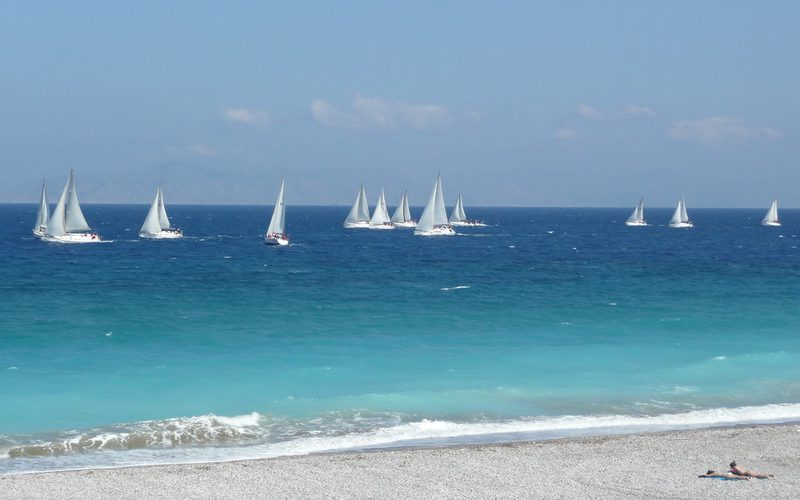
No guide to sailing Greece is complete without a frank discussion of the Meltemi. This north-to-northwest seasonal wind system dominates the central and northern Aegean from late June through late August. At its peak, it blows Force 5–7 (20–35 knots) for days at a time, making some passages genuinely challenging for inexperienced crews. It rises in the morning, often building through the afternoon, and drops at sunset — which is why experienced Greek sailors move early, anchor by noon, and wait out the afternoon breeze over a long lunch.
The Meltemi is not something to fear but something to plan around. Passages from north to south are fast and exhilarating; beating back northward requires patience. In the Ionian, a different system — lighter, more variable winds — means conditions are more relaxed in summer. Tipos recommends that first-time sailors in Greece discuss the wind calendar in detail with their charter company before finalising a route.
Best Time to Sail Greece
The sailing season effectively runs from April to October, but the peak differs by experience level and preference:
- April–May — Quiet marinas, lush green islands, cool but swimmable sea, occasional rain. Ideal for experienced sailors who want space and solitude. Prices are low.
- June — Warming seas, growing Meltemi but still manageable, a good balance of weather and crowds. Many sailors call this the sweet spot.
- July–August — Peak season. Marinas are full, anchorages get busy by afternoon, and the Meltemi can be fierce. Also the most spectacular: intense blue skies, warm water, vivid light.
- September–October — Crowds thin, the Meltemi weakens, seas stay warm. Many experienced sailors consider September the finest month in Greece. Restaurant owners are relaxed and generous; harbours have room.
Chartering a Yacht: Bareboat vs Skippered vs Flotilla
There are three standard ways to charter a yacht in Greece, and each suits a different kind of sailor.
Bareboat charter means you take the helm yourself. You will need to show a qualifying sailing certificate (an RYA Day Skipper or equivalent is usually the minimum, with an ICC — International Certificate of Competence — required by Greek law), pay a security deposit, and demonstrate enough experience to satisfy the charter company. In return, you get complete freedom: your route, your pace, your anchorages. Costs range from around €800 to €5,000+ per week depending on the vessel size and season.
Skippered charter — also called a crewed charter — adds a professional skipper (and often a hostess or chef) to the vessel. You become a passenger with as much or as little involvement in the sailing as you choose. This is the option Tipos highlights most often for families, corporate groups, and anyone who wants the experience of Greece by sea without the certification demands. Costs are higher but the experience is unmatched.
Flotilla sailing is the ideal stepping stone for sailors who have some experience but are not yet confident enough for a bareboat passage. A lead boat carrying a professional skipper, engineer, and hostess sails with a fleet of yachts — typically eight to twelve — stopping at the same anchorages each night so crews can share meals, swap stories, and get help when they need it. For those who want the security of My Greece Tours-style organised travel combined with the thrill of actually sailing the boat, flotilla is the perfect compromise.
Key Charter Bases and Their Advantages
Greece’s charter industry is large and mature. The main bases are:
- Lefkada, Ionian — The most popular base in Greece for good reason: the Ionian is forgiving, the lagoon anchorage at Lefkada town is beautiful, and dozens of operators base large fleets here. Easy access from airports in Preveza and Corfu.
- Alimos Marina, Athens — The largest marina in Greece, just 20 minutes from Athens airport. Saronic Gulf sailing is on your doorstep, and the fleet here is enormous. Convenient for short breaks.
- Lavrion, Attica — Quieter than Alimos, closer to the Saronic and the Cyclades. Good choice if your itinerary heads south toward Kea and Kythnos.
- Rhodes — Gateway to the Dodecanese. If your route runs through Symi, Tilos, or Patmos — that sacred island of the Dodecanese with its hilltop monastery and tranquil bays — then basing out of Rhodes makes obvious sense.
- Kos — An alternative Dodecanese base with a lively charter scene and excellent port infrastructure.
- Thessaloniki/Kavala — Entry points to the northern Aegean and Sporades, popular with experienced sailors wanting fewer crowds.
Island Highlights: The Must-Sail Destinations
While every sailor’s Greece is different, certain islands appear on almost every recommended itinerary, and for good reason.
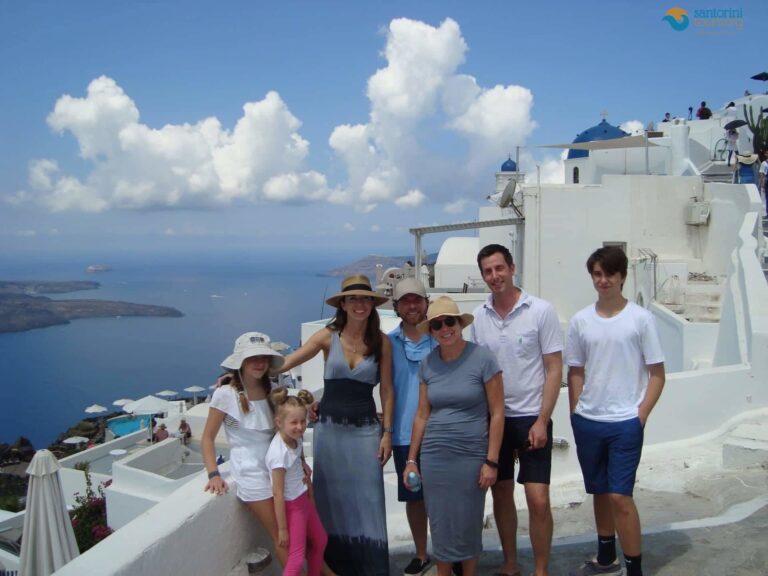
Santorini is a sailing destination like no other. The caldera — the flooded crater of a volcanic eruption — offers one of the most dramatic anchorages in the world. You drop the hook in 30 metres of turquoise water ringed by black cliffs, with the white villages of Fira and Oia perched on the rim above you. The sailing approach from the north, watching the cliffs rise from the sea, is a memory that stays with sailors for life. Tipos notes that a private sailing excursion around the caldera, combining the famous sunset view with a swim in the hot springs, ranks among the top experiences in the Greek islands — exactly the kind of experience that makes Santorini private tours so sought-after by travellers who want something beyond the ordinary tourist circuit.
Sifnos is one of those islands that sailors discover and then return to every year. Quieter than its Cycladic neighbours, it combines a superb natural harbour at Kamares with some of the finest food in the Aegean. The island is a champion of slow, authentic Greek tourism, making it an ideal stop for sailors who want to actually live on an island for a day or two rather than simply pass through. Whether you are pursuing Sifnos hiking trails through wild thyme and rosemary, or simply sitting in a harbour café watching the fishing boats come in, the island rewards unhurried attention.
The Saronic Gulf deserves special mention for its convenience. The islands of Hydra, Spetses, and Poros are all within a short sail of Athens and all three are car-free — the streets of Hydra, in particular, are navigated by donkeys and people on foot. Dropping anchor in Hydra harbour and going ashore for coffee has a timeless quality that makes Tipos return to this circuit repeatedly in its island coverage.
The Northern Aegean — Thassos, Samothraki, and the Sporades — rewards sailors with dense forest, quieter harbours, and an older, less commercialised version of Greek island life.
Navigating Greek Waters: Charts, Apps, and Regulations
Greek waters are generally well-charted but depths can change rapidly, particularly around smaller islands and in channels. Reliable paper charts (British Admiralty, Imray, or Hellenic Navy) should always be on board alongside digital tools. The most popular navigation apps in the region include Navionics and iSailor, both of which have good Greek coverage, including marina data and point-of-interest layers.
Regulatory requirements for sailing in Greek waters include: carrying life jackets for every person on board, a valid ship’s radio licence and VHF radio, flares, a fire extinguisher, and anchor equipment meeting minimum specifications. Foreign flagged vessels must also carry their registration documents and, for bareboat charters, the transit log from the charter company. Greece is part of the EU Schengen area, so movement between Greek islands is unrestricted for EU citizens; non-EU sailors arriving from outside the EU must clear customs at an official port of entry.
Top Marinas and Anchorages
Greece is investing heavily in marina infrastructure. Flisvos Marina in Athens, the new Lefkada town pontoons, and the expanded facilities at Rhodes Commercial Harbour are all modern and well-managed. But the soul of Greek sailing lies in the smaller anchorages — the ones where you are the only boat, the water is impossibly clear, and the only sound is the wind in the rigging.
Some of the most beloved include:
- Fiskardo, Kefalonia — Arguably the prettiest harbour village in the Ionian. Venetian architecture, excellent restaurants, reliable holding ground.
- Vathy, Ithaca — Homer’s island. The landlocked bay is one of the safest hurricane holes in the Ionian and the village is genuinely lovely.
- Meganisi — A small island south of Lefkada with three intimate bays, crystal water, and a population that has barely changed in decades.
- Naousa, Paros — A working fishing harbour that doubles as one of the best nightlife spots in the Cyclades.
- Symi — Arguably the most beautiful harbour in the Dodecanese, with neoclassical mansions painted in ochre and terracotta climbing the hillside above the quay.
- Skiathos Town — Lively, well-provisioned, with easy access to the pine-fringed beaches of the Sporades.
Getting There: Arriving in Greece for Your Charter
Most international sailors arrive by air. Greece’s main international hubs are Athens International Airport (Eleftherios Venizelos) and Thessaloniki Airport (Macedonia), with direct connections from across Europe, North America, and beyond. Secondary airports serving the main charter bases — Corfu, Preveza (for Lefkada), Rhodes, Kos, and Mykonos — receive a large volume of direct seasonal flights from northern Europe throughout the summer.
From the airport to the marina, taxis and pre-booked transfers are the most reliable option. Many charter companies will arrange a pick-up as part of the handover package. For those flying into Athens and sailing the Saronic, Alimos Marina is less than 30 minutes from the airport by taxi — a genuinely smooth transition from plane to boat. Tipos also notes that the major international airports serving Greek charter hubs consistently rank among Europe’s better-organised facilities; indeed, those curious about how Greek aviation infrastructure measures up globally will find comparisons on lists of the world’s cleanest airports enlightening.
Provisioning Your Yacht
One of the great pleasures of sailing Greece is provisioning. Most islands have at least a small supermarket, a bakery, and a farmers’ market where you can buy local olive oil, honey, oregano, tomatoes, and cheese. The larger towns — Lefkada, Kos, Rhodes, Heraklion — have supermarkets equivalent to anything in Western Europe. In smaller anchorages, a daily boat sometimes comes alongside offering bread, vegetables, and fish.
Fuel and water are available at most marinas and at many village quays. Diesel prices in Greece are in line with Mediterranean averages. Fresh water can be scarce on some smaller islands in August, so top up whenever you have the chance and treat your water tanks as a limited resource.
Sailing Safety and Road Rules at Sea
Safety on Greek waters follows standard COLREGS (International Regulations for Preventing Collisions at Sea) as well as local rules around protected anchorages and no-anchor zones near Posidonia seagrass meadows. The Hellenic Coast Guard monitors VHF Channel 16, which is the distress and calling frequency; all vessels should maintain a radio watch on 16 at all times underway.
One often-overlooked aspect of sailing safety in Greece is the transition from boat to road when you step ashore to rent a scooter or a car. Tipos has published practical advice on road safety — and the points about adjusting to local driving conventions are worth reading before you pick up keys on any Greek island, where roads can be narrow and traffic unpredictable.
Where to Eat and What to Order
Food is one of the defining joys of a sailing holiday in Greece, and the fact that you are arriving by sea gives you access to restaurants that most tourists never find. Look for the ones with fishing boats tied directly to the terrace — those tend to be the freshest. Grilled whole fish (ask what came in that morning), grilled octopus, fresh-shucked sea urchin from the dive mask of the taverna owner’s teenage son — these are not culinary clichés but real and available experiences.
Regional variations matter. In the Ionian, the Venetian influence shows up in rich sauces and sweet preparations that you won’t find in the Aegean. In the Dodecanese, the proximity to Turkey introduces flavours — spiced rice-stuffed vine leaves, spit-roasted meats — that are subtly different from the mainland. The Cyclades are known for their exceptional cheese (the graviera of Naxos is extraordinary), their capers, and their fava (split pea purée), particularly on Santorini.
Sailing with Children
A sailing holiday in Greece is genuinely child-friendly if planned correctly. The Ionian, with its calm water and short passages, is the obvious starting point for families. Children of all ages can help with light deck tasks — trimming sails, watching for dolphins, working the anchor windlass — and the combination of swimming, snorkelling, and island exploration keeps them engaged without a screen in sight.
Tipos recommends keeping passages under four hours when sailing with children under ten, anchoring in bays with sandy beaches wherever possible, and choosing a skippered or flotilla charter for the first trip so the adults can focus on the children rather than the navigation. Greek islands are, on the whole, very safe places for children, and the warmth that locals show toward families is a constant pleasure.
Organised Tours vs Independent Sailing: Making the Right Choice
The choice between booking an organised sailing tour and going independently is one of the first decisions any visitor to Greece must make. Both paths have genuine advantages, and the right choice depends on your experience level, party size, and how you prefer to travel.
Independent bareboat sailing gives you the highest degree of freedom but demands confidence, certification, and a willingness to take responsibility for everything from weather routing to engine maintenance. For experienced sailors, this is the purest form of the experience.
Organised sailing tours — whether flotilla packages, skippered charters, or blue-water rally itineraries — remove the logistical burden and add community. You arrive at the marina, step aboard a clean, ready boat, and a professional crew handles the rest. The Tipos team consistently highlights the quality of the Greek charter industry, which has evolved significantly over the past two decades into a service that rivals anything available in the Caribbean or the Adriatic. For those weighing these options, resources like the experts at My Greece Tours offer structured packages that take the planning off your hands and let you focus on the sailing itself.
A Sailing Planning Checklist
- Choose your sailing region based on experience level (Ionian for beginners, Cyclades for intermediates, Dodecanese for experienced sailors).
- Book your charter company at least 3–4 months ahead for peak-season departures.
- Gather and digitise all required documents: sailing certificates, passport, ICC if required, vessel insurance.
- Plan your route with alternates — the Meltemi can close some passages; always have a backup anchorage.
- Brief your crew on safety: life jacket locations, man-overboard procedure, VHF operation.
- Provision for at least two days in advance; never rely on a single resupply point in remote areas.
- Download offline charts to your navigation app before departure — mobile data is patchy in many anchorages.
- Pack light: sailing lockers are small, and gear left ashore is gear that doesn’t slow you down at sea.
- Check your travel insurance covers sailing activities in Greek waters.
- Register a float plan with someone ashore who can alert the Coast Guard if you don’t make contact.
Frequently Asked Questions About Sailing in Greece
Do I need a licence to charter a yacht in Greece?
Yes. Greek law requires that the skipper of a chartered vessel hold a recognised sailing certificate. An RYA Day Skipper (or its national equivalent) combined with an ICC (International Certificate of Competence) satisfies most charter companies. Some operators will accept a detailed logbook showing equivalent sea miles in lieu of formal certification — discuss your experience with the company before booking.
What is the best region for a first sailing trip to Greece?
The Ionian Islands, based out of Lefkada or Corfu, are the standard recommendation for first-timers. Winds are lighter and more consistent than the Aegean, passages are short, and the islands are close together. The infrastructure is excellent and the scenery — emerald water, green hills, Venetian harbours — is stunning without being demanding.
How long a trip do I need to see the highlights?
A one-week charter (Saturday to Saturday is the industry standard) is enough to cover a single region well — for example, the central Cyclades or the northern Ionian. Two weeks allows a more ambitious circuit: Athens Saronic to Cyclades, or Ionian to Cephalonia and back. Tipos recommends that first-time visitors prioritise depth over distance — three islands explored properly are more rewarding than seven visited briefly.
Is sailing in Greece expensive compared to other Mediterranean destinations?
Greek charter prices are broadly competitive with Croatia and Turkey, and generally lower than the French and Italian rivieras. A bareboat sailing yacht accommodating six to eight people costs roughly €1,200–€3,000 per week in shoulder season, rising to €2,500–€6,000 in high summer depending on size and specification. Provisioning, marina fees, and fuel are additional costs; however, eating and drinking in Greece remains significantly cheaper than in Western Europe, which balances the equation.
Can I sail around multiple island groups in a single charter?
It is possible but requires careful planning. Moving between the Ionian and the Aegean, for instance, requires a significant offshore passage around the Peloponnese — typically one to two days of serious sailing. Most first-time visitors are better served by choosing one region and exploring it deeply. For those with two weeks and offshore experience, a Corfu-to-Athens transit via the Ionian coast and Saronic Gulf is a classic Greek sailing passage that Tipos highly recommends.
Conclusion
Sailing and yachting in Greece is not merely a holiday activity — it is one of the most immersive ways to encounter a civilisation that has shaped the world for three millennia. From the rock-cut harbours of the Dodecanese to the caldera of Santorini, from the wildflower hills of Sifnos to the Venetian campaniles of the Ionian, every anchorage is a chapter in a story that keeps unfolding. Tipos continues to document this story for travellers who want to engage with Greece at its most authentic — follow the coverage, plan your route, and cast off.
Read More
- Top New Healthy Lifestyle
- Private Greece Tours
- Why You Should Visit Santorini
- Home Maintenance Advice
- Natural Remedies for Burns and Cuts
- Shipbroker Association Seminars
About the Author