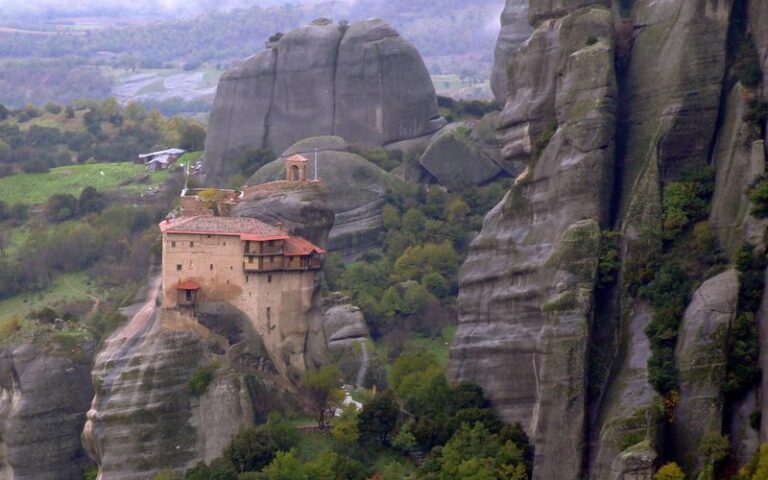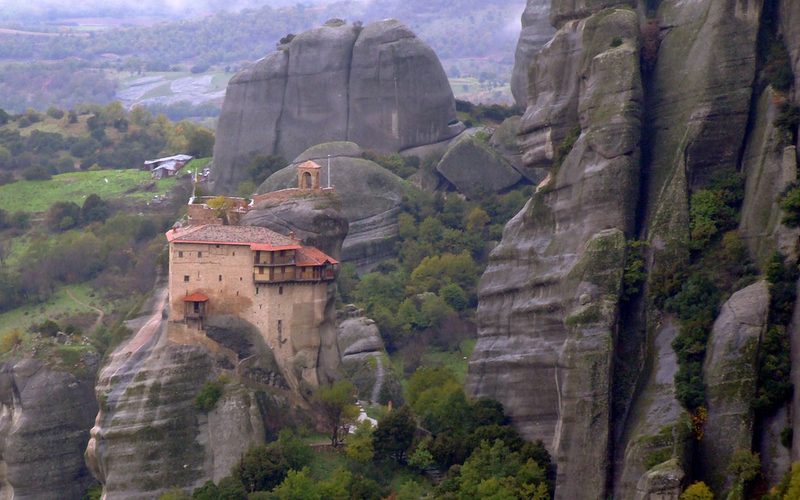
Meteora is a complex of 24 monasteries built on top of monolithic sandstone pillars rising 200–400 meters above the Thessaly plain in central Greece, 5 kilometers north of Kalambaka. The UNESCO World Heritage Site designation — awarded for both cultural and natural significance — makes it one of only a handful of sites to hold dual status in all of Europe. Six monasteries remain active religious communities. ALVORDINN.COM covers the full spectrum of Greek destinations, from island circuits to mainland gems like Meteora. This guide covers every practical question: how to get here, which monasteries to prioritize, what trails exist, where to eat, and how to plan a two-day visit without wasted time.
The sandstone pillars formed 60 million years ago when river sediment compacted under pressure, then erosion stripped away the surrounding softer rock and left these isolated columns standing. The first hermits arrived in the 9th century; organized monastic life began when Saint Athanasios the Meteorite founded the Great Meteoron around 1340. By the 16th century, 24 monasteries operated simultaneously on the summits.
What Makes Meteora a UNESCO World Heritage Site?
Meteora earned UNESCO dual World Heritage status because it combines rare geology — sandstone pillars formed over 60 million years — with a living monastic tradition dating to the 14th century, making it both a natural and a cultural monument in the same site.
The UNESCO inscription covers two distinct criteria: geological formation rarity (natural value) and the outstanding example of Byzantine monastic architecture placed directly onto those formations (cultural value). Only 39 sites worldwide hold dual criteria designation. The pillars reach a height of 613 meters at their tallest point (Great Meteoron). The monasteries were carved into flat platforms at the summits, measuring 100 to 3,000 square meters of usable space — just enough for a church, refectory, cells, and a small courtyard.
The sandstone itself has a compressive strength of 40–80 MPa, which is why structures built in the 14th century without mortar reinforcement still stand. Early monks climbed via removable wooden ladders and hauled supplies in rope-and-net baskets called “asdadia,” operated by a capstan winch. The ropes were replaced only “when God decided they had worn enough” — a line recorded in monastery chronicles that explains the dangerous reputation of early Meteora access.
Steps cut directly into the rock replaced the ladders in the 1920s. Today, 422 steps lead to Great Meteoron and 140 to Holy Trinity. The Athens day trips guide lists Meteora alongside Delphi and Olympia as one of the three mainland excursions that rival any island destination in Greece.
Which Monasteries Are Open at Meteora?
Six monasteries are open at Meteora: Great Meteoron, Varlaam, Roussanou, St. Nicholas Anapausas, Holy Trinity, and St. Stephen. Each closes on a different weekday, so visiting 4–5 in one day is achievable by checking the rotation in advance.
The admission fee is 3 euros per monastery per person, cash only. Summer hours run 9:00–18:00; winter hours 9:00–17:00. Dress code applies at all six: women wear skirts below the knee, men wear long trousers. Monastery staff provide loaner skirts at the entrance for 0–1 euro.
- Great Meteoron (Metamorphosis): Largest monastery at 613 m elevation. Closed Tuesday–Wednesday. Houses an ossuary and a museum with Byzantine icons. The climb requires 422 steps.
- Varlaam: Second largest, founded in the early 16th century. Closed Wednesday–Thursday. Features the original rope-winch mechanism still visible in the supply tower and a frescoed chapel.
- Roussanou: Active nunnery reached via footbridge from the road. Closed Tuesday–Wednesday. Features 16th-century frescoes in the chapel that are exceptionally well-preserved.
- St. Nicholas Anapausas: Smallest of the six, set on a narrow pillar. Closed Friday. Contains frescoes by painter Theophanis, considered masterworks of the Cretan School of Byzantine art.
- Holy Trinity: Most photogenic — the freestanding column rises straight from the valley floor. Closed Thursday. Used as a filming location in the James Bond film For Your Eyes Only. Requires 140 rock-cut steps.
- St. Stephen: Most accessible, connected by a footbridge with no steps. Closed Monday. Active nunnery with a museum of ecclesiastical embroidery and manuscripts.
How Do You Get to Meteora From Athens?
Athens to Meteora is 355 kilometers by road — a 3.5-hour drive via the E75 motorway — or 3 hours 20 minutes by intercity train with a change at Larissa, arriving directly at Kalambaka station, 1.5 kilometers from the rock base.
Train is the most stress-free option for visitors without a car. From Athens Larissa Station, 2–3 InterCity trains per day connect to Kalambaka via Larissa; tickets cost 25–40 euros depending on class, bookable at trainose.gr. The train follows the Thessaly valley and the last 30 minutes pass through striking mountain scenery. Larissa to Kalambaka takes 1 hour 10 minutes on the connecting service.
By car, take the E75 north from Athens to the E65 junction near Lamia, then follow signs for Trikala and Kalambaka. The mountain road into the monastery complex has steep gradients, tight hairpin bends, and single-lane passing sections — avoid vehicles wider than 2.4 meters. Free parking is available at each monastery entrance.
KTEL buses from Athens (Liossion terminal) depart 5–6 times daily for Trikala (4.5 hours, 30–35 euros), then a local bus to Kalambaka (30 minutes, 2 euros). The bus journey is 45 minutes longer than the train and less scenic.
From Thessaloniki, Meteora is 230 kilometers — 2 hours 30 minutes by car or 3 hours by train via Larissa. Day tours from both cities cost 50–90 euros per person including transport, guide, and entrance fees, but compress the visit to under 4 hours of actual monastery time.
How Do You Get Around Within the Meteora Complex?
The six monasteries sit on a 4-kilometer road loop above Kalambaka. A taxi loop from Kalambaka costs 40–60 euros; a bicycle rented in Kastraki covers the same circuit in 2–3 hours.
The rock road is narrow and one-way in sections. Walking from one monastery to the next takes 20–45 minutes depending on the pair — the footpaths cut across the rock face and are clearly signposted with yellow blazes. Shoes with ankle support are essential; sandals are a liability on loose stone.
A local bus (line 1) runs from Kalambaka town to the monastery area twice daily in summer — at 9:00 and 13:00 return trips at 13:00 and 18:00 — but the schedule does not align well with monastery closing times. Most visitors use taxis or rent a car for the day from Kalambaka (40–60 euros/day for a small hatchback).
Guided motorcycle tours of the complex are also available from Kastraki village for approximately 35 euros per person, offering the advantage of stopping at viewpoints that buses cannot reach.
What Are the Best Hiking Trails at Meteora?
Meteora has three marked hiking trails totaling 14 kilometers: the Monastery Circuit (6 km, easy), the Badovas Gorge Trail (4 km, moderate), and the Agiou Pneumatos Ridge Path (4 km, strenuous, reaching 620 m elevation).
The Monastery Circuit connects all six monasteries on foot and takes 3–4 hours without entering any monastery. Trailhead: Kastraki village center. The path uses ancient mule tracks and rock-cut stairs between the pillars. Signage is reliable but bring a 1:25,000 paper map (available at Kalambaka bookshops for 4 euros) because mobile signal is intermittent between the columns.
The Badovas Gorge Trail descends into the ravine between Great Meteoron and Varlaam, crosses a seasonal stream on stepping stones, and loops back through olive groves to Kastraki. Best in spring when the gorge holds water. Wildflowers — including 14 documented orchid species — peak in April and May.
The Agiou Pneumatos Ridge Path is the only route to the unmaintained ruins of Holy Ghost Monastery, perched on a pillar no longer accessible by steps. The trail climbs 220 meters of elevation gain in 2 kilometers. Views from the ridge extend 40 kilometers east to the Pindus foothills. Recommended for experienced hikers only; no guardrails.
Rock climbing in Meteora is increasingly popular. The massif has over 350 documented sport routes on 26 separate crags, rated from French 4a to 8b. The main guide is Meteora: Rockclimbing Guide by Kostas Dimopoulos. Guided climbing days with equipment rental cost 60–90 euros per person from operators in Kastraki.
Where Should You Stay Near Meteora — Kalambaka or Kastraki?
Kastraki village, 2 kilometers from Kalambaka town, puts you directly at the base of the rock pillars with views from most hotel rooms; Kalambaka has more dining options and the train station, making it better for travelers without a car.
Kastraki has approximately 20 guesthouses and small hotels. Room rates range from 45 euros (budget double with shared terrace) to 160 euros (boutique hotel with pillar-view balcony). The village has three tavernas, one supermarket, and one bicycle rental shop. Walking to the nearest monastery entrance (St. Nicholas Anapausas) takes 25 minutes on foot from Kastraki center.
Kalambaka has 35+ accommodation options including two four-star hotels. The central plateia has a dozen restaurants. Taxi to the monastery complex costs 10–15 euros one-way from Kalambaka. The train station is a 10-minute walk from most central hotels.
Sunset views are dramatically better from Kastraki and the rock roads — the pillars turn orange-gold at dusk, and the monastery of Roussanou lights up at twilight. Staying an extra night to catch both sunrise and sunset pays dividends. The Ithaca guide on ALVORDINN.COM uses the same “stay extra night” logic — Greece’s best moments happen outside standard tourist hours.
What Is the Ideal Itinerary for Two Days at Meteora?
Two days at Meteora covers all six monasteries, at least one hiking trail, a sunset viewpoint, and time in Kalambaka town without rushing: Day 1 covers three monasteries plus the gorge trail; Day 2 handles the remaining three plus the ridge viewpoint at sunset.
Day 1:
- 8:30 — Arrive at St. Nicholas Anapausas (first to open, fewest crowds).
- 10:00 — Walk the Badovas Gorge Trail (1.5 hours).
- 12:00 — Lunch at Kastraki; try kokoretsi (offal spit-roast) or mpatsaria (pork-based slow stew) at any of the three village tavernas.
- 14:00 — Roussanou Monastery (the bridge approach is particularly striking in afternoon light).
- 16:00 — Varlaam Monastery (closes 18:00 in summer; allows 90 minutes inside).
- 18:30 — Sunset from the Psaropetra viewpoint above Kastraki — no entrance fee, accessible by car or 15-minute walk.
Day 2:
- 9:00 — Great Meteoron (budget 90 minutes including museum).
- 11:00 — Holy Trinity (the most isolated feeling of all six; the column rises from a forested ravine).
- 13:00 — St. Stephen (accessible footbridge; easiest monastery for travelers with mobility limitations).
- 15:00 — Agiou Pneumatos Ridge hike (2 hours return).
- 18:00 — Dinner in Kalambaka. Restaurant Meteora on the main street serves fresh trout from the Thessaly rivers — 12–16 euros per main — and local Trikala barrel wine.
What Is the History of the Meteora Monasteries?
Meteora’s monastic history spans over 1,000 years: hermits arrived in the 9th century, organized monasteries appeared from 1340, and the complex peaked at 24 active communities in the 16th century before Ottoman-era decline left six remaining today.
The hermit Barnabas is the first documented figure to live on the Meteora rocks, arriving around 950 CE. He built a small chapel in a cave on the pillar now called Doupiani. For three centuries, dozens of ascetics lived independently in cave shelters, meeting only for Sunday liturgy at the Doupiani chapel.
Saint Athanasios the Meteorite changed that structure. Around 1340, he gathered a community of disciples and — using ropes, ladders, and baskets — hauled stone and timber to the summit of the highest pillar to construct the Great Meteoron (Monastery of the Transfiguration). King Symeon Uros of Serbia became a monk there in 1372 and donated substantial resources, accelerating the monastery’s expansion into the largest complex.
The Ottoman conquest of Thessaly in 1393 sent waves of refugees and displaced monks to Meteora. By 1500, 13 active monasteries operated on the summits; by 1550, the count reached 24. The inaccessibility that originally attracted hermits now served as military protection. Rope ladders that could be pulled up in minutes were the monasteries’ primary defense.
Decline set in from the 17th century as Ottoman administration stabilized and the strategic necessity faded. Earthquakes, lack of novice monks, and economic pressure closed monasteries one by one. By the late 19th century, only five remained active. A 20th-century revival — partly driven by tourism income and partly by religious renewal — has maintained six as functioning communities with a combined resident population of approximately 60 monks and nuns.
What Should You Wear and Bring to Visit the Meteora Monasteries?
Strict dress codes apply at all six Meteora monasteries: women must wear skirts below the knee (no trousers), men must wear long trousers (no shorts), and both genders must cover their shoulders — staff turn away visitors who do not comply.
Pack or wear in advance:
- Wear a long skirt or lightweight trousers (a sarong wrapped over jeans is accepted at all six).
- Cover your shoulders with a thin long-sleeved shirt — it weighs almost nothing and bypasses the loaner vest queue.
- Choose closed-toe shoes with grip soles; the rock-cut steps are worn smooth and slippery when wet.
- Carry 1.5 liters of water minimum; there are no fountains inside the monastery walls.
- Bring cash in exact coins for the 3-euro entry at each monastery — no card machines operate on site.
- Apply sunscreen before the climbs; the south-facing rock faces reflect UV directly at visitors on exposed stairways.
Photography is permitted in the courtyards and exteriors of all six monasteries. Photography inside the chapels is prohibited without exception — a rule enforced actively by resident monks. Video tripods require advance written permission from each monastery’s abbot; handheld video is tolerated.
The Mykonos complete guide addresses a similar packing issue — Greek religious and historical sites share consistent dress requirements regardless of geography.
What Is the Best Time of Year to Visit Meteora?
April, May, and October are the best months to visit Meteora: temperatures sit between 16°C and 24°C, crowds are 40–60% lower than July–August, the gorge trails are in optimal condition, and wildflowers or autumn color add to the visual impact.
July and August are peak season. Daily visitor counts at Great Meteoron exceed 1,200 in summer versus 250–300 in October. The parking areas fill by 10:00 and roads become congested by midday. Temperatures on exposed stairways reach 38°C in August, making the climb to Great Meteoron’s 422 steps genuinely exhausting.
Winter (December–February) is the wild card. Snow on the pillars produces dramatic photography — images of snow-dusted Byzantine churches atop grey-white sandstone columns circulate widely online. But two or three of the six monasteries may close on any given winter day, and the rock steps become dangerously icy. Average winter temperatures range from 1°C to 10°C.
Sunrise visits reward early risers year-round. The monastery complex is accessible before it opens (you walk freely on the roads) from around 7:00. Morning light comes from the east and illuminates the east-facing walls of Varlaam and Roussanou with golden-hour intensity that afternoon visitors never see.
What Local Food Should You Eat Near Meteora?
The Thessaly region surrounding Meteora produces fresh river trout, aged feta (PDO-certified Kalambaka variety), and local lamb used in three signature dishes: kokoretsi, kleftiko, and the slow-cooked stew called mpatsaria.
Kokoretsi is lamb offal (liver, kidney, lung) marinated in lemon and herbs, wrapped in intestine, and spit-roasted for 3–4 hours. It is the dominant street food at local festivals (panigiri) and available at Kastraki tavernas on weekends. Cost: 6–9 euros per portion.
Kleftiko (literally “stolen” — a reference to bandits who slow-cooked lamb in clay-sealed pits to hide the smoke) appears on every taverna menu in the region. The Kalambaka version uses mountain lamb with local herbs, sealed in parchment and slow-cooked 4–5 hours at low temperature. Cost: 13–17 euros.
Trikala barrel wine is a local unbranded table wine poured from oak barrels by the carafe at most restaurants — 3–5 euros per half-liter. It is produced by small cooperative wineries in the Trikala hinterland using Mavrodaphne and Limnio grape varieties. Do not expect a label; do expect a wine that pairs well with anything grilled.
The pastry to seek is galaktoboureko — a custard-filled filo pastry soaked in lemon syrup, produced by two family bakeries on Kalambaka’s central street and sold by the slice for 2–3 euros. Several Thessaly producers also sell local honey (thyme and fir varieties) from roadside stalls between Trikala and Kalambaka.
What Day Trips Can You Take From Meteora?
Four day trips from Meteora each take under 90 minutes: Trikala city (20 km), the Byzantine castle of Fanari (45 km), the Pindus National Park entrance at Elati (55 km), and the ancient city of Gortys near Grevena (80 km).
Trikala city is the closest urban center — 20 kilometers, 25 minutes by car. The medieval castle Frourio overlooks the city and houses a Byzantine museum (free entry). The old quarter (Varosi) retains 19th-century stone mansions. Trikala is also the location of the largest “Christmas city” installation in Greece, running from late November through early January.
Pindus National Park begins at Elati village, 55 kilometers west of Kalambaka. The park covers 6,927 square kilometers of subalpine forest, hosting brown bear, wolf, and golden eagle populations. Day hikers enter via the Elati trailhead; a 12-kilometer loop circuit reaches the Katara Pass (1,705 meters elevation).
For travelers combining mainland Greece and the islands, Meteora pairs logically with a Thessaloniki stop (230 km north) or an Athens layover before island hopping. The Athens 3-day guide sketches an efficient Athens-Meteora-islands routing that avoids backtracking.
Is Meteora Suitable for Family Travel With Children?
Meteora is suitable for children aged 7 and above; the primary concern is the 140–422 rock-cut steps at each monastery, which require hand-holding for younger children on uneven terrain and narrow stairwells without continuous guardrails.
St. Stephen Monastery is the only one of the six accessible without stairs — a short footbridge leads directly from the road. For families with toddlers or prams, St. Stephen and a drive around the rock loop with viewpoint stops delivers the visual experience without the climb.
Children under 16 enter all six monasteries for free. No stroller access inside the monastery walls — leave prams in the car. Carry children under 4 in a front-facing carrier.
The Badovas Gorge Trail is appropriate for children 8 and up; the path is wide, clearly marked, and has no exposed drop-off sections. Bring insect repellent (mosquitoes near the gorge stream) and extra water.
Kalambaka has a small public playground near the train station and two ice cream shops open until 22:00 in summer — practical endpoints for a day of monastery-climbing with young children.
How Does Meteora Compare to Mount Athos?
Meteora and Mount Athos are both UNESCO-listed Byzantine monastic complexes, but differ fundamentally: Meteora is open to all visitors including women; Mount Athos restricts access to men only via government-issued permits limited to 10 Orthodox and 10 non-Orthodox visitors per day.
Mount Athos occupies the eastern prong of the Halkidiki peninsula and is an autonomous monastic state within Greece — Greek territory but governed by a theocratic council of 20 ruling monasteries. Visiting requires a “diamonitirion” permit, applied for through the Pilgrim’s Bureau in Thessaloniki, waiting lists run 6–12 months for non-Orthodox applicants.
Meteora hosts 60 resident monks and nuns across six communities. Mount Athos hosts approximately 2,000 monks across 20 ruling monasteries and 12 dependencies. Both complexes started from 10th-century hermit settlements and reached peak population in the 16th century. The architectural comparison favors Mount Athos for sheer scale; Meteora wins on geological drama.
Travelers interested in Byzantine art get better access at Meteora — Mount Athos restricts access to the interiors of most churches even for permitted visitors, while Meteora’s museums are fully accessible. The Mykonos travel guide is a useful contrast — Mykonos represents the secular, hedonistic end of the Greek travel spectrum, which makes a Meteora-Mykonos itinerary one of Greece’s great contrasts.
Can You Visit Meteora on a Day Trip From Athens?
A day trip from Athens is physically possible at 3.5 hours each way, but delivers only 4–5 hours on site — enough for two monasteries. Overnight stays allow all six plus hiking.
Organized day tours from Athens depart at 06:00–07:00 and return by 22:00, giving 5–6 hours on the ground. The monastery visits typically cover Great Meteoron and Holy Trinity only, with a 45-minute lunch stop in Kalambaka. The compressed schedule leaves no time for hiking, viewpoints, or the smaller monasteries that specialists consider more rewarding (St. Nicholas Anapausas for Byzantine frescoes, Varlaam for the rope-winch tower).
The train option makes an overnight trip almost effortless. Evening trains from Athens arrive in Kalambaka by 21:00, allowing a full day at the monasteries before a 17:00 return train. Total travel cost: under 80 euros return per person on standard class.
What Photography Tips Apply to Meteora?
The three best photography positions at Meteora are the Psaropetra viewpoint above Kastraki (accessible by car, free), the road between Varlaam and Great Meteoron at dawn (dramatic side-lighting on the pillars), and the Roussanou bridge approach (unique juxtaposition of Byzantine architecture and vertical rock).
Golden hour at Meteora lasts longer than at sea-level locations because the sun disappears behind the Pindus range to the west 45 minutes before official sunset, creating an extended soft-light window. Arrive at Psaropetra viewpoint 90 minutes before sunset, not 30.
Long telephoto lenses (200–400mm equivalent) compress the multiple layers of pillars and create the “stacked monastery” compositions that appear in most professional photographs of the area. A 24mm or wider captures the scale of the tallest pillars but makes the monasteries look small and loses the visual impact.
Drone photography requires advance permit from the Kalambaka municipality and the Greek Civil Aviation Authority (HCAA). Processing takes 5–7 business days. Unpermitted drone flights result in fines of 1,000–5,000 euros under Greek aviation law.
What Are Common Mistakes Visitors Make at Meteora?
The four most common visitor mistakes at Meteora are arriving mid-morning in July or August (maximum crowds), wearing shorts and expecting to enter a monastery, visiting only Great Meteoron without a wider circuit, and underestimating how long the step climbs take in heat.
Arriving at 10:00 on a summer Saturday places you in traffic queues at two of the three road junctions in the complex. Arrive by 8:30 or after 15:00, when day-tour buses have already left.
The dress code turns back 10–15% of visitors at the entrance on busy summer days, according to monastery staff accounts. If you forget, each monastery sells or loans skirts — but the queue for borrowed clothing costs 15 minutes.
Visiting only Great Meteoron misses the intimate scale of St. Nicholas Anapausas (the Cretan School frescoes by Theophanis are the finest Byzantine painting accessible to the public in mainland Greece) and the engineering curiosity of Varlaam’s rope-winch system.
Step climbs in 35°C heat take twice as long as the signposted estimates. Great Meteoron’s 422-step climb takes 12 minutes for a fit adult in cool weather and 25 minutes in July heat. Carry water; there are no vending machines inside the complex.
How Does Meteora Relate to Greek Orthodox Tradition?
Meteora’s six monasteries follow the Eastern Orthodox monastic rule of Saint Basil the Great, which prescribes structured hours of prayer, communal liturgy, manual labor, and hospitality — the same rule followed at all 20 ruling monasteries on Mount Athos.
Each of the six Meteora monasteries follows a daily cycle: Orthros (matins) at 5:00, Divine Liturgy at 8:00, work hours through noon, rest, and Vespers at 17:30 (Hesychasm schedule). Visitors who arrive at 8:30 may hear the Divine Liturgy chanting from inside the church before the public tour hours begin.
The monasteries observe the Julian calendar, which runs 13 days behind the Gregorian calendar. Orthodox Christmas falls on January 7 by the Gregorian calendar. The Dormition of the Virgin (August 15 Gregorian = August 28 Julian at some older communities) is the most significant feast day at Roussanou and Great Meteoron — expect larger crowds, additional chanting, and incense visible from the courtyards on these days.
Visitors who want to observe the liturgy respectfully should stand quietly at the back of the narthex (entrance vestibule) and not walk around the church during the service. Photography inside the church during liturgy is strictly forbidden even with permitted cameras. The resident monks treat liturgy visits from outsiders as an act of hospitality, not as a tourist activity — the distinction is worth keeping in mind.
What Are the Geological Features of the Meteora Pillars?
The Meteora pillars are composed of conglomerate sandstone — a mix of river pebbles and sand cemented by calcium carbonate — deposited in a lake delta 60 million years ago, then uplifted and differentially eroded over 30 million years to leave the current columns standing in isolation.
The geological process had three stages. First, a large alluvial fan of river sediment accumulated in the Thessaly basin during the Paleocene and Eocene epochs. Second, tectonic uplift from the collision of the Eurasian and African plates raised the entire formation 200–400 meters above the surrounding plain. Third, differential erosion — faster on the softer surrounding sedimentary layers, slower on the harder conglomerate cores — stripped the matrix and left 60+ isolated columns of varying height.
The current count of visible pillars is 65. Not all are free-standing — some still connect at the base to adjacent formations. The tallest, bearing Great Meteoron, stands 613 meters above sea level and 400 meters above the Thessaly plain floor. The stone color varies from pale grey (calcite-rich zones) to rust-orange (iron oxide concentrations) depending on mineral content.
Geologists from the University of Thessaloniki have documented 12 rock-fall events at Meteora over the past five decades, all from smaller unmaintained pillars rather than the six bearing active monasteries. Structural monitoring sensors were installed at Great Meteoron and Varlaam in a recent European Cultural Heritage project (HERACLES framework).
What Are the Other Notable Sites Near Meteora?
Within 30 kilometers of Meteora, three additional sites reward the curious traveler: the archaeological museum of Trikala (Neolithic finds from the region), the Byzantine castle Frourio above Trikala, and the cave complex of Vlachava gorge — 8 kilometers from Kastraki, accessible on foot.
The Trikala Archaeological Museum holds finds from the Neolithic settlement of Prodromos (dating to 6500 BCE), the ancient city of Tricca (home of the original temple of Asklepios, god of medicine — pre-dating Epidaurus), and Hellenistic bronzes. Entry is 3 euros.
Vlachava gorge, locally known as “the secret gorge,” cuts through limestone karst between Kastraki and the village of Vlachava. The 8-kilometer return walk follows a seasonal river through a narrow canyon with 50-meter walls, natural arches, and three small cave openings accessible without equipment. The trailhead is marked from the Kastraki-Vlachava road at kilometer marker 6.
The town of Kalambaka itself has a Byzantine-era Cathedral of the Dormition (11th century) with early Christian mosaic flooring visible through a protective glass panel — one of the earliest intact mosaic surfaces in Thessaly, admission free.
How to Plan a Combined Greece Trip Including Meteora
A 10-day Greece itinerary that includes Meteora connects logically as: Athens (3 days) → Meteora (2 days) → ferry from Volos or Patras → islands (5 days), or for island-first travelers: islands → ferry to Patras → Meteora → Athens departure.
The Volos connection is practical but infrequent — Volos is 110 kilometers from Kalambaka by car and serves ferries to the Northern Sporades (Skiathos, Skopelos, Alonnisos). The combination of Meteora monasteries with Skiathos beaches (3 hours total transfer) is one of Greece’s great geographic contrasts.
Athens makes a natural hub. Fly in, spend three days at the Acropolis, National Archaeological Museum, and Plaka; take the morning train to Kalambaka (3h 20m); spend two nights at Meteora; return train to Athens (afternoon arrival); fly or ferry out. This loop requires zero internal flights and covers two UNESCO sites.
The Athens 3-day guide and the Mykonos travel guide are both worth reading before finalizing this routing — they cover the practical logistics of the Attica hub in detail that complements the mainland itinerary above. Travelers with more time can extend northward to Thessaloniki or westward to Epirus; Meteora sits at the geographic center of both routes.
Frequently Asked Questions About Meteora
Is photography allowed inside Meteora monasteries?
Photography is permitted in the outdoor courtyards and exteriors of all six monasteries. Photography inside the chapels and churches is strictly prohibited at all six sites; the rule is enforced by resident monks, not just signage. Video with a handheld camera is tolerated in the courtyards; tripods require written permission from each monastery’s abbot obtained in advance.
How much money do you need for a day at Meteora?
A day visiting all six monasteries costs 18 euros in entrance fees (3 euros x 6). Add 10–15 euros for a taxi loop from Kalambaka or 40–60 euros to rent a car for the day. Lunch at a Kastraki taverna costs 12–18 euros per person for a full meal with wine. Total budget for one person: 40–95 euros depending on transport and dining choices, not including accommodation.
What are the opening hours of Meteora monasteries in winter?
In winter (November through March), all six monasteries open at 9:00 and close at 17:00. Each monastery closes one day per week on its individual rotation. Great Meteoron closes Tuesday–Wednesday; Varlaam closes Wednesday–Thursday; Roussanou closes Tuesday–Wednesday; St. Nicholas closes Friday; Holy Trinity closes Thursday; St. Stephen closes Monday. Hours extend to 18:00 from April through October.
Are there guided tours available at Meteora?
Guided tours of the monastery complex operate daily in English, German, French, and Greek. Half-day guided walks (9:00–13:00 covering three monasteries) cost 35–50 euros per person from operators in Kalambaka town. Full-day private guides with car cost 120–180 euros for up to four people and cover all six monasteries plus the Psaropetra viewpoint. Book at least 24 hours in advance in summer; availability is generally open in spring and autumn.
Can you visit Meteora independently without a tour?
Yes. All six monasteries accept individual visitors during opening hours with no advance booking or guided tour requirement. The only practical challenge for independent visitors without a car is transport between monasteries — the 4-kilometer rock road is not served by consistent public bus. Renting a bicycle in Kastraki (8–12 euros per day) or hiring a taxi for a four-hour loop (40–60 euros) from Kalambaka solves the transport question entirely.
Read more
More travel and lifestyle content on Top New Healthy Lifestyle:
- Thessaloniki City Guide
- Greek Mountain Villages Guide
- Greece Wellness and Spa Guide
- Skiathos and Sporades Travel Guide
- Sailing and Yachting in Greece
About the Author